Vasia Brykin
Doctor ZhivagoVasia Brykin is a sixteen-year-old ironmonger's apprentice whose accidental conscription carries him from family separation and flight to a new life in Moscow as a student of printing and book design. His course through the novel links the impersonal force of labor requisition to the destruction of a rural home, but also to the friendships and practical work through which he begins again.
Identity and Background
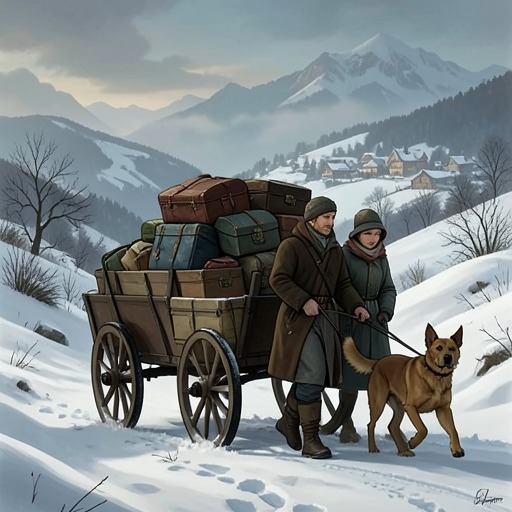
Vasia is among the labor conscripts transported in a train convoy. A boy apprenticed to an ironmonger, he had been sent from his home in Viatka province to Petrograd by his widowed mother after his father was killed in the war. His youth and innocence distinguish him within the crowded car: he is described as attractive and unspoiled, and as someone who sits at the feet of his elders, listening closely to their conversations and stories.
His connection with Prokhor Kharitonovich Prituliev begins with geography. Both come from Viatka province, and the train passes through their native region. When Prituliev names familiar villages and routes, Vasia repeats the place-names with excitement, as if hearing about a marvellous fairy tale. The conversation makes the journey’s distance personal: the train is carrying him through a landscape he recognizes, while also carrying him away from the life he had there.
How He Is Conscripted
The circumstances that place Vasia in the labor corps begin with his uncle’s mistake. His uncle kept a private shop in Apraksin Yard and was summoned by the local soviet for questioning. Mistaking the entrance, he walked into the labor corps selection board’s office. Soldiers later surrounded the men there, took them to the Semenov barracks overnight, and escorted them to the Vologda train in the morning.
At the station, the prisoners’ families came to say goodbye. Vasia’s uncle asked Private Voroniuk, the guard assigned to the convoy, to let him briefly see his wife. Voroniuk would not release him without a guarantee that he would return. Vasia and his aunt were offered as hostages, and the guard agreed to let the uncle out. When the family’s deception became clear, Vasia understood that he had been left behind in his uncle’s place. He wept, fell at Voroniuk’s feet, and begged to be released, but the guard refused. The narrative explains that Voroniuk’s refusal arose from the strict discipline of the convoy, not personal cruelty: he was accountable for the number of prisoners under his charge, with their presence checked at roll call.
Kostoied-Amursky, an experienced co-operativist respected by jailors under both Tsarism and the present government, repeatedly raised Vasia’s case with the convoy’s commander. The officer acknowledged that it was a terrible misunderstanding but cited formal obstacles to examining it before their arrival and promised to do what he could. The account therefore presents Vasia’s conscription not as the result of a considered decision about his conduct, but as the consequence of bureaucratic confusion reinforced by the convoy’s rules.
Flight and the Loss of Home
Vasia later escapes with Tiagunova. In the wilderness he urges her to continue toward a village, where he believes local people will shelter them, rather than risk dying of hunger. He says they have had nothing to eat for two days and imagines that Voroniuk must have raised an alarm and that their former companions, including Prituliev, will catch up with them. His confidence and effort to reassure Tiagunova stand against the precariousness of their situation: she is frightened and barely speaks, while he presses on with a practical plan for reaching safety.
When Vasia encounters Zhivago again, he is a barefoot, ragged water carrier. He recognizes the doctor from the same train and throws himself down before him, kissing his hands and weeping. Their reunion reveals what has happened during the separation. Vasia’s native village, Veretenniki, has been burned, and his mother is dead. During the destruction he hid in a cave in the quarries. His mother, believing he had been taken to town, went mad with grief and drowned herself in the Pelga, the river flowing below the cliff where Vasia speaks with Zhivago. His sisters, Alia and Aria, are said to be in an orphanage in another district, but Vasia has no reliable news of them.
Vasia leaves for Moscow with Zhivago, telling him on the way about the many terrible events he has experienced. The return to the city does not restore the family or home he lost; it opens a different possibility through a relationship with a friend who can offer concrete help.
Education and Work with Zhivago
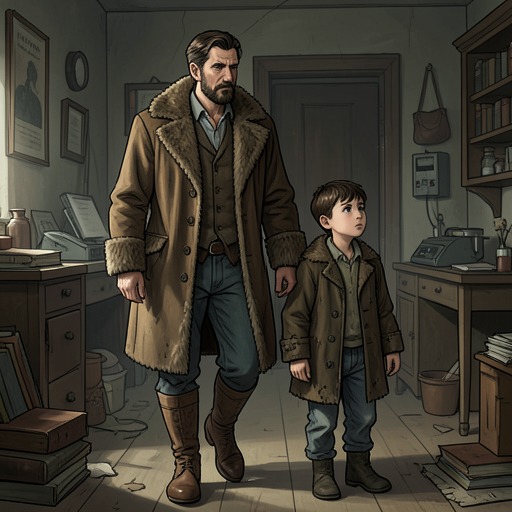
Vasia tells Zhivago that, while apprenticed to his uncle, he used to play with charcoal when no one was watching. Zhivago responds by considering what could be done with this interest. Vasia does not show exceptional talent in drawing, but has enough aptitude to enter a school of industrial design. With help from Zhivago’s friends, he is admitted to the institution that had been the Stroganov Institute.
He first studies general subjects and then specializes in printing, bookbinding, and book design. The course gives a practical form to his earlier apprenticeship and his interest in drawing, without suggesting that he becomes a celebrated artist. His achievement lies instead in learning a craft through which another person’s writing can be made and circulated.
Zhivago and Vasia work together on booklets. Zhivago writes them, and Vasia sets the type and prints small editions as part of his training. Their friends distribute the publications through recently opened secondhand bookshops. The collaboration makes Vasia more than a recipient of assistance: his technical labor helps bring Zhivago’s ideas and literary work into the world.
Relationships and Narrative Significance
Vasia’s relationships repeatedly reveal the human consequences of impersonal systems. His uncle’s attempt to see his wife leaves Vasia and his aunt as guarantees; the guard’s responsibility for the convoy’s headcount makes the mistaken arrangement difficult to undo; and the officer’s recognition of the error cannot immediately overcome formal obstacles. Kostoied-Amursky’s advocacy, meanwhile, shows that people within the system can acknowledge the injustice even when they cannot promptly correct it.
His later bond with Zhivago develops through recognition, aid, and shared work. The former doctor and the former conscript meet again by chance, but their relationship becomes sustained and productive: Zhivago helps Vasia gain admission to design school, and Vasia helps print the doctor’s booklets. This movement from a boy whose future is decided by a mistaken exchange to a trained printer engaged in making and distributing texts gives his arc a clear change in agency. The novel does not restore what the war and village destruction have taken from him; instead, Vasia’s education and collaboration establish a fragile, practical continuation of life amid displacement.